






Margarita Cheesecakes- and My Best Cheesecake Tips
This past 4th of July, I was once again privileged to celebrate with my Oakland pals – Keith and Beth, and David and Susan. It’s always great to cook alongside Keith with his Hawaiian sensibility. This year he grilled a pork loin seasoned with Hawaiian smoked salt, cumin and smoked paprika, among other things, and the requisite Hawaiian potato salad with elbow macaroni.
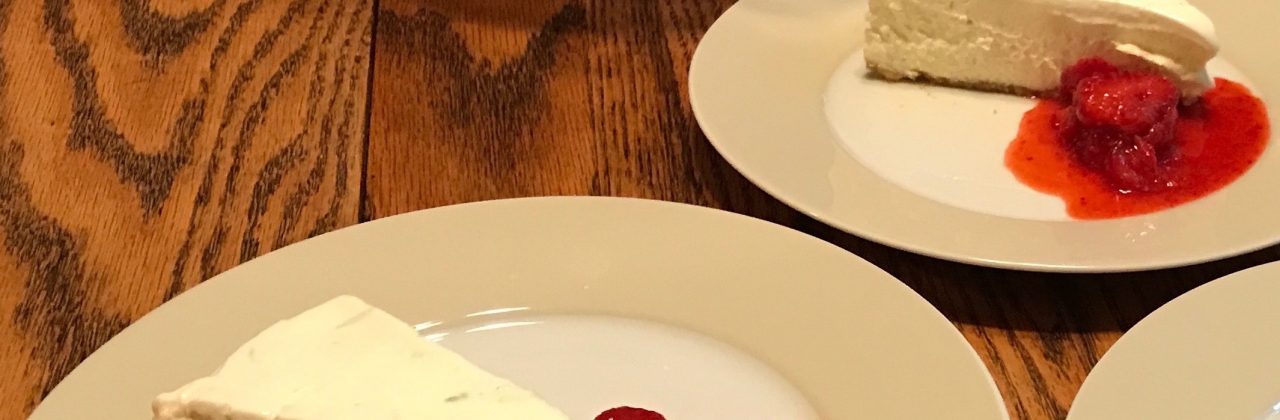
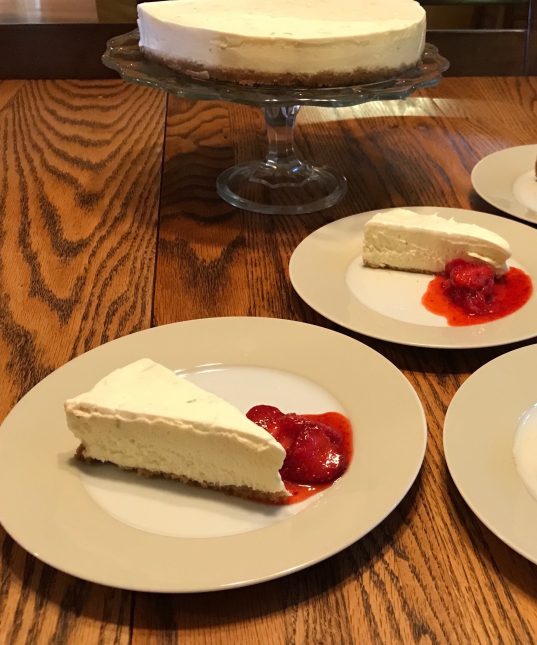
I prepared a lentil and corn salad with charred tomatoes and sautéed kale, and to everyone’s delight (yeh!), a Margarita Cheesecake. David pronounced it one of the best cheesecakes he’d ever had (perhaps a bit of hyperbole), and said it was the embodiment of what he thought a cheesecake should be.
Really, it wasn’t that unusual a recipe – well, it does have a pretty high ratio of sour cream to cream cheese, making it extra creamy. I do believe, however, that this is a case where adhering to good technique (and ingredients) produces an extraordinary result. So maybe it’s a good time to be reminded of the finer points of mixing and baking a cheesecake.
When I was in culinary school, Jake, my cake baking instructor (he liked to joke that he wanted a cooking show called Bake with Jake) drilled into us the importance of using Philadelphia brand cream cheese, and no other if we wanted an always smooth, lump free and creamy cheesecake. I have to say that over the years, I have come to completely agree with him, so that’s my first tip.
The next is making sure that all your ingredients are at room temperature – important advice when mixing any cake batter, but I think it’s especially important with a cheesecake. I let my cream cheese and eggs sit out overnight. If there is sour cream in the batter, it doesn’t sit out overnight, but do take it out of the fridge about an hour or so before adding to the batter. One of the keys to a good creamy cheesecake is not over mixing. When all your ingredients are at room temp, very little mixing is required to fully incorporate them.
Which leads me to my third, and maybe most important tip. A cheesecake batter should be mixed at a very low speed. I mix mine at only 2 – the lowest speed on a KitchenAid stand mixer, just barely above the “stir” speed. The reason being you don’t want to incorporate air into a cheesecake batter – which is just the opposite of what you want in a butter creamed or egg foam raised flour cake batter – to achieve the smooth creaminess. And btw, if your cream cheese has been sitting out overnight you’ll barely need to mix it to incorporate.
Lastly, Jake taught us to put the sugar into the mixing bowl first, then add the cream cheese. The graininess of the sugar helps to smooth and cream the cheese. And if you can find extra-fine, or baker’s sugar, that’s a big plus. The fine grind of the sugar, again, incorporates more easily into the cream cheese.
After baking in a water bath, I also allow my cheesecake to cool in the oven for about an hour or two (using a wooden spoon, or some other kitchen tool to prop open the oven door), after turning off the oven heat, to allow a very gradual cooling down. This is to prevent the cake from cracking due to a too rapid cool down.
Having said all that, cheesecakes are a very easy and fairly forgiving cake. In fact, I think the one thing that can mess them up, is over mixing. And they are always prepared ahead of time, so they’re a great party dessert. Even though this one was baked a day ahead of being served, we found that its flavor continued to improve on the third and fourth day (we’ll assume you’ll have leftovers).
Of course, it didn’t hurt that this particular cheesecake was full of Tequila, Triple Sec and lime – both juice and lots of the zest.
Enjoy!
Ingredients
-
- 1 1/2 cups vanilla wafers crumbs, finely ground
- 1/4 cup sugar
- 1/4 cup melted butter
-
- 24 ounces Philadelphia brand cream cheese
- 7 ounces extra fine sugar
- 3 eggs
- 2 cups sour cream
- 3 tablespoons Triple Sec
- 4 tablespoons Tequila
- Juice of 1 large lime, about 3 tablespoons
- Zest of 1 lime, finely grated
-
- 1 cup sour cream
- 2 tablespoons extra fine sugar
- 2 tablespoons fresh lime juice
- Zest of 1 large lime, finely grated
-
- 1 1/2 cups strawberries, sliced
- 2 tablespoons sugar
- 2 tablespoons Triple sec
- A squeeze or two of lemon juice, to brighten up the taste
Instructions
-
- Place a removable bottom springform pan over a large piece of foil. Tightly crimp the foil up the sides of the pan to prevent the filling from leaking. Repeat with a second piece of foil for double wrapping of the pan.
- Combine in a large bowl, the vanilla wafer crumbs and sugar.
- Toss with butter while turning the bowl to mix in evenly.
- Test by squeezing a handful of the crumbs in your fist to see if it holds together. If needed add a tiny bit more butter or egg white, then press into the bottom of the pan.
- Bake at 375 degrees for @ 8 to 10 minutes until the crust is set and very slightly browned.
- Remove and let the crust cool completely.
-
- Place the sugar first, then the cream cheese in the large bowl of a stand mixer.
- Mix on the lowest speed until the sugar is completely incorporated and the cheese is creamy.
- Add the eggs one at a time mixing slowly again.
- Then add the sour cream. again mixing very slowly.
- Stir in the Tequila, Triple Sec and lime juice and zest.
- Pour the filling over the cooled crust.
- Place the cheesecake in a larger pan. Put the pan in a 325 degree oven, then pour hot water into the larger pan, filling to about halfway up the cheesecake pan.
- Bake for 50-55 minutes, until the filling is set at the sides but still very slightly jiggly in the center.
- Turn the oven off, and prop the door open with a wooden spoon letting the cheesecake cool down in the oven for about an hour.
- Remove the cheesecake from the oven, remove the foil from the side of the pan, and let the cake cool completely on a wire rack. When it is completely cool, place the cake on top of a large piece of plastic wrap, then bring up the sides of the plastic wrap, completely wrapping the cake. Refrigerate overnight.
- To remove the cheesecake from the pan, wipe the sides of the pan with a hot cloth, then run a very thin spatula around the sides of the cake before releasing the spring form. Lift the sides from the cake, then run a very thin long knife under the cake, sliding it carefully on to a cardboard round or flat plate. If you like, you can just leave it on the pan bottom and serve it from there.
-
- In a small bowl, lightly whisk together the sour cream, sugar, lime juice and zest.
- Spread the topping evenly over the cooled cheesecake. You will most likely have some topping leftover.
- Sprinkle the sugar over the strawberries and allow to sit for a few minutes so the berries can release some of their juices.
- Then stir in the Triple Sec. Adjust with the lemon juice to taste. If necessary, stir in a bit of water to loosen the sauce.