





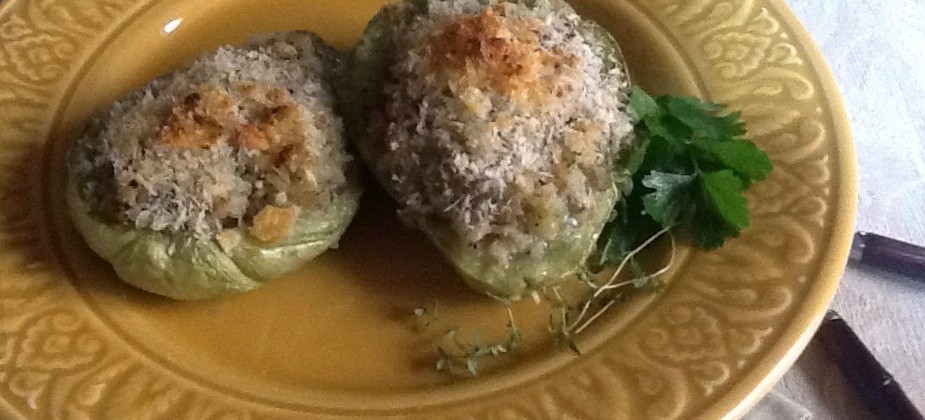
Stuffed Mirlitons (aka Chayotes)
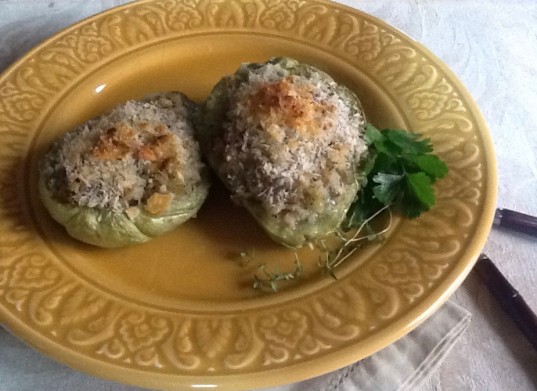
There are three items you’ll find on almost every holiday table throughout the city of New Orleans. They are oysters, sweet potatoes and mirlitons. In fact, mirlitons and sweet potatoes become loss leaders in the every grocery stores from the week before Thanksgiving until Christmas. The first two will probably come as no surprise to you, but some of you may even be asking yourself, “just what the heck is a mirliton”? For my So Cal friends, they are pretty indistinguishable from chayote (and in the Caribbean they are known as christophines) although a few years back, following the BP Gulf Oil spill, I learned from Slow Food’s list of indigenous Gulf foods at risk, that although they are very closely related, chayotes are spiny and mirlitons are smooth skinned. Nowadays that distinction is lost in typical grocery shopping.
Most commonly, the mirlitons would be served individually stuffed – at least that was the traditional way – although some now, in order to save time I imagine, will serve the stuffing as a casserole without bothering to do the work of stuffing each vegetable shell.
A side note – several years back when I was researching traditional Spanish tapas for a client’s birthday party, I was pleasantly surprised to learn how important little stuffed vegetables were in that cuisine. About a year before that, I had the opportunity to chat with southern Louisiana chef, Teryl Jackson, former chef at the renown Cajun restaurant Prejean’s, and now a culinary consultant who told me in his opinion, that one of two key differences between Creole food and Cajun, was the use of vegetables in Creole cuisine, especially side dish creations using seasonal vegetables – just like these little stuffed mirlitons. You’ll also traditionally find eggplant, peppers, artichokes, even tomatoes served stuffed and cooked in the cuisine. I put two and two together, and delightedly came to the conclusion that I had stumbled on a direct Spanish influence on Creole cuisine – one not discussed nearly as much as the French, African and even Native American influences. Which leads to another little discussed fact – for as long as New Orleans has existed, its citizens have preferred identifying with the French, while in actuality, New Orleans was a Spanish colony for at least as long as it was a French colony. Okay – I know it may seem weird, but little findings like this make me happy. And I’ve digressed…
My Uncle Reiss likes to say that we cooked our vegetables three times here, and indeed these are. The mirlitons are halved and cooked in the oven to soften the inner meat, which is then scooped out and cooked with the aromatics, meat and seafood, then stuffed into shells and baked again. Most often, the mirlitons are stuffed with shrimp (which are in such abundant supply here) combined with diced ham. I made them recently to take to a last minute Thanksgiving meal, and used what I had on hand- which was crab meat – not bad, either, or you can go a little wild and use both shrimp and crabmeat.
I hope you’ll give these a try- and you don’t have to wait for the holidays.
P.S. If you want to try a couple of really wonderful sweet potato dishes for your holiday meal, here are a couple that can’t be beat:
Candied Yams (the more traditional dish)
and Sweet Potato Purée with Pecan Praline Topping (an updated creative take on tradition)
[amd-yrecipe-recipe:11][amd-yrecipe-recipe:11]