
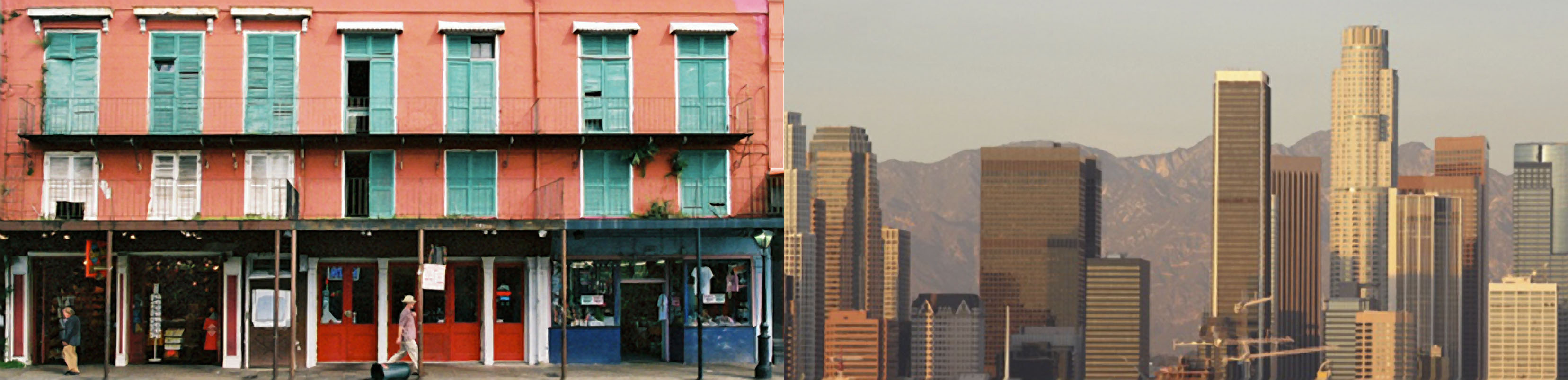






A City of Immigrants

As I am writing this, the city of Los Angeles is under siege – under siege because the current administration in Washington DC has targeted it – sent Immigration Control and Enforcement agents to pull people off the streets, out of businesses – out of Home Depot parking lots, out of car washes, out of restaurant kitchens and clothing factories – to enforce its immigration policies. And it has sent in the National Guard, against the will of the city’s Mayor and the state’s Governor, to quell peaceful and legitimate protests against the administration’s terror. I am in the last couple of days of a week plus long visit to L.A. – the city my parents moved my brothers and me to as young children, the city where I grew up, and the city where I spent over half my life. The city has shaped me as much as the city of New Orleans, the city of my birth and ancestors, which in itself is a city of immigrants. Los Angeles is, of course, and always has been a city completely shaped by immigrants – a city which has freely welcomed immigrants throughout its history. Immigrants currently make up over 35 percent of the County of Los Angeles’ total population. And the city has benefited greatly from its immigrants’ contributions over the years. It would not be what it is – it would have no culture, no industry or no prosperous economy without immigrants. The city is dotted with smaller neighborhood designations – Little Armenia, Little Tokyo, Thai Town, Chinatown, Koreatown, Little Ethiopia, Filipinotown, and of course, its founding square is Olvera Street, at the heart of downtown – a lasting tribute to the city’s Mexican founders (at least half of whom were Afro-Mexican) and immigrants who live throughout the city. It’s hard for me to even begin to know how to talk about how important immigrants have been to this city, and is it my hope and intention to work out my feelings on paper further over the next few days and weeks. For starters, I can’t help think of the industry which the city is known for throughout the world built by European Jewish immigrants. And the fact that L.A. has become a world class food city – a destination food city, thanks in large part to immigrants, who lead and man the city’s many restaurants. Additionally, anyone growing up in Los Angeles grew up eating Mexican food. We, of course, in our own homes ate the food of wherever our family hailed from, but Mexican food for me (and no doubt others) was like a second mother, and I, like so many others, still love it. I was lucky enough, as a child, to sit at the table many a night, at the home of my best early grade school friend, Lillia. Lillia’s family were recent immigrants to the city – her mother spoke almost no English, but her cooking spoke to my heart. I was always welcome in their home, and at their table. Lillia’s mother would deftly pat masa de harina into tortillas right beside us at the table, throw them on to a sizzling griddle, and present them to us, piping hot, to scoop up braised meats, beans and rice, with a slice...
read more

