







A Stop at Sánchez-Romate Bodega

Ironically two of the top highlights of my tour of southern Spain occurred in the somewhat working-class town of Jerez de la Frontera – a town that might be passed over by some, considering all the other great cities on Spain one could visit. The morning after the two nights of breathtaking flamenco performances at the Festival de Jerez, we made our way to the Sánchez-Romate Bodega (winery), before heading out of town and on to our next city, for a private tour. Jerez is a city world famous for its Sherry (the word sherry itself is a derivation of Jerez). This particular winery has a long history in the storied region – founded in 1781 by wealthy noblemen, and still run today by the same family. They produce Sherry, Sherry Vinegars and Brandy. Their Cardinal Mendoza is one of the highest qualities brandies produced in Spain. Sherry wines are fortified wines, meaning brandy is added to the wine to preserve it. Better for all those long 18th and 19th century hauls across the Atlantic, right? While other preservation methods now exist, brandy fortification is still used because of the distinct flavors it can add to the wines. We learned that there is a wide range of Sherry varieties, from the pale Manzanillas and Finos, though the amber Amontillados, on to the darker ambers bleeding into mahoganies of Olorosso, all the way to the deep mahogany colored Pedro Jimenez – which to me was really a sipped dessert. I didn’t get to try all the varieties – it was morning, after all, but I absolutely loved the complex burnt sugar flavors in a glass of the Pedro Jimenez. Just skip the dessert and have it with some cashews and blue cheese. Heaven! And to top off the morning, we were lavishly entertained by master classical guitarist and collaborator with many of flamenco’s greats, Alfredo Lagos. All in all, a Sunday go to church experience for me. Luckily for you, I taped a small portion of the concert to share with you now. Click on the link below to view the unlisted video:...
read moreTraveling through Cádiz – and Beyond
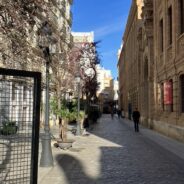
A ramble down an old Cádiz street When I told a friend about my upcoming trip shortly before I left, she said (even though she was encouraging to me), “I’m only a New World person”. And it’s true – I, too, have traveled almost exclusively in the New World. But the New World emerges from the Old. Traveling through Cádiz (the oldest city in Western Europe, founded initially by the Phoenicians and later part of the Roman empire), I witnessed my Old World roots in a personal way – learning that this was the birthplace of the trans-Atlantic slave trade, as this port city held the exclusive licensing agreement with the port of Havana in the New World (as early as the 16th century). I wasn’t the only one. Cári, an Afro-Cuban woman traveling with us, was visibly moved after our walk through the port of Cádiz, and learning the history. The connections that I had seen Ned draw, and his insistence on tracing the African roots echoing through southern Spain – in the dance, in the music, in the history and architecture – was one of the things that initially drew me to this tour. I was chasing the breadcrumbs of the “long song” (a phrase coined by early jazz musician, transplanted from New Orleans to Europe, Sidney Bechet), as I took to calling it – the song that echoes across the Atlantic, to the Gulf of Mexico and the Caribbean. I had learned from Ned, in reading his book, that Havana was the capital of the Spanish colonies in North America. And indeed, there was a steady flow of trade (most obviously and importantly, the slave trade) between Havana and New Orleans, lasting from the 1600’s all the way up to the embargo levied in the 1960’s. It’s because of the embargo, still in place, sadly, that there is so little memory of this connection today. The Port of Cádiz The remnants of a Roman amphitheater in old Cádiz We passed the Calle de los Negroes there – in the African section of town. In the old town square of Cádiz, I was excited to see the statue of Moret, a celebrated 19th century politician. I have numerous Moret (almost all of whom believed their ancestry was French), cousins and ancestors in my extended family line. Emilio J. Rodríguez Posada, CC BY-SA 2.0 https://creativecommons.org/licenses/by-sa/2.0, via Wikimedia Commons It wasn’t Cádiz alone, though. As if visiting there wasn’t enough connection to my history, after I had begun planning this trip, I received an e-mail out of the blue, from a distant and unknown cousin, telling me that my own 3rd great-grandfather had left the coastal town of Sitges, south of Barcelona, to sail to Louisiana in the 18th century. Breadcrumbs. Pretty amazing, right? When I first began looking into visiting Barcelona, a few people had mentioned that it was worth adding on a side trip to the beautiful little town of Sitges. Now I just had to go. So to end my time in Spain, I added on a couple of days there. It was the perfect place to wind down at the end of this intense 3 weeks. This Mediterranean coastal town was like most coastal towns. There was beach volleyball, people out walking their dogs alongside...
read more

